 Indonesia
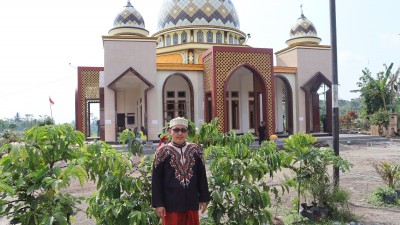
Under the splendor of Hyang Raung,
precisely in Slateng Village, Ledokombo District, Jember Regency, East Java,
stands the At-Tanwir Islamic Boarding School which is also known as the “Coffee
Islamic Boarding School”. As the name implies, namely the light that
illuminates the surroundings, Ponpes At-Tanwir is like a lantern that emanates
from under Hyang Raung. His radiance seeks to penetrate into the darkness of
the problems faced by society. It's not just an educational issue, but also a
social and economic issue.
On Saturday (16/10), I had the
opportunity to chat with Kyai Zainul Wasik, the caretaker of the Islamic
boarding school. Accompanied by the wafting aroma of Raung's coffee, we chatted
at length starting from the history of the hut, the relationship between coffee
and the hut, to the story of how At-Tanwir came to be known as the “CoffeePesantren”.
*
The story of Pesantren Kopi began in
2006. Kyai Zainul Wasik, who was only 27 years old at that time, initially
founded a play and study group for children around the village of Slateng.
After walking a few days, he began to notice something odd: the children who
joined him were not in school. In addition, he also discovered the fact that
although Slateng Village has great economic potential, 80 percent of its people
choose to work as manual labor outside the city and even abroad.
After exploring further, he found a
number of factors that led to the high number of children dropping out and not
attending school there. "It turns out that the problem lies in cost, time,
and culture," said the kyai from Mayang District. Departing from that
problem, he then ventured to open an open junior high school in 2008. This
junior high school later became the forerunner of Ponpes At-Tanwir.
“Over the past 1-2 years,
administrative problems have arisen, because on average children have not been
in school for a long time, we have to invite and understand their parents
slowly. At first, the children didn't want to wear uniforms, they didn't want
to wear shoes, so it's okay, the important thing is to wear polite clothes
first,” he recalled.
Over time, the process of educating
the public regarding the importance of education by Gus Danil, Kyai Zainul
Wasik's nickname, has begun to bear fruit. One of the indicators is that since
2010 many parents have entrusted their children to Gus Danil. Mainly, parents
entrust their children to deepen their religious knowledge there.
"At that time I asked her
parents again, is it not wrong to leave their child here, we are not a cottage,
we are only a place to study. We don't have a prayer room, toilets, girls'
dormitory …,” he said.
“But it turns out that parents still
persist in entrusting their children and trusting us. Then more and more
children are being entrusted with it," he added.
However, that does not mean the
problem of education disappeared entirely. During that same period, Gus Danil
had repeatedly dismantled teachers and arranged schedules so that the targets
for learning activities in junior high school could be met. The reason is, when
the harvest season arrives, many children skip school to help their parents
harvest coffee in the gardens and forests.
“At that time, I felt it was unfair,
how come I have decided that coffee is a problem but I don't know it in detail.
Finally I tried to dive in, I learned from seeding to processing. And finally
found that coffee not only saves economic potential, but also forms the
cultural identity of the people here.”
In order to continue to study and
find common ground between coffee and education, Gus Danil is getting serious
about getting into the world of coffee. There, he not only studied the coffee
processing process, but also how coffee forms social bonds, togetherness, and
the potential for economic and social improvement of the community in the future.
“Finally, I found a bit of common
ground on how the coffee that has permeated the identity and culture here can
be used for the transformation of society. That is through education. From
here, Pondok At-Tanwir was born and later known as Pesantren Kopi, because
indeed all development, fulfillment of learning support infrastructure, and
student education costs are waiting for the coffee harvest money," he
explained.
In order to realize community
independence through coffee processing, apart from being equipped with
religious knowledge, the students at PP At-Tanwir were also given education
related to coffee processing from upstream to downstream. The goal is none
other than so that after leaving the cottage, the students can contribute to
managing the large potential of Raung coffee.
"Especially the students who
come from this area, we provide education from the selection of seeds, sorting,
to coffee processing. So that in the future the potential for coffee here can
be managed by local residents themselves. Also, so that they are grateful that
they can eat, go to school, live here, that is Allah's sustenance through the
intermediary of coffee."
Now, it has been almost 11 years
since the At-Tanwir Islamic Boarding School was established. His efforts to
continue to contribute to the betterment of society are starting to bear fruit.
It was under Hyang Raung that he stood and shone for society.
Get Pesantren Kopi products here.